New Resource: Top 10 Energy Companies in Canada for Decarbonization & Industrial Audiences (2026)
Discover the key players shaping Canada’s energy transition and industrial power landscape, ahead of Industry Connect Canada 2026.
Navigating Canada’s energy transition in 2026 means understanding who holds the power—literally. As hyperscale data centres compete with heavy industry for electrons and carbon pricing reshapes project finance, knowing which companies are driving the most consequential decisions is critical.
Our new report cuts through the noise to identify the energy companies that matter most for industrial energy buyers, financiers, and project developers. Featuring a curated, alphabetical list of ten key players, this resource goes beyond market cap to spotlight organizations actively shaping grid reliability, low-carbon baseload, and oil sands decarbonization economics.

New Resource: Top 10 CCUS Leaders in Canada – A Comprehensive Breakdown of the Companies Driving Scalable Carbon Management
Explore the key players, technologies, and infrastructure projects shaping Canada’s carbon capture landscape, ahead of Industry Connect Canada 2026.
Canada is rapidly establishing itself as a global powerhouse in carbon capture, utilization, and storage, with a national goal to capture over 15 million tonnes of $\text{CO}_2$ annually by 2030. Yet, navigating the complex web of project momentum, technology developers, and regional storage hubs requires a clear picture of who is truly driving operational progress.
Our new report offers an essential guide for industry stakeholders, investors, and decarbonisation leads looking to understand the core operators and technology innovators transforming the market. Based on project scale, active execution, and 2025–2026 momentum, the list evaluates top leaders across the entire CCUS value chain—from world-scale pipeline networks and commercial saline aquifer storage to modular capture retrofits and direct air capture (DAC) innovations. Featuring key operational milestones from front-runners like ATCO EnPower, Deep Sky, Enhance Energy, and Svante, this resource provides the strategic insights you need to identify partners, track infrastructure buildouts, and position your organization at the forefront of Canada’s energy transition
New Resource: The Smart Plant Retrofit Checklist – A Practical Tool for Identifying Low-Risk, High-Impact Emissions-Cutting Levers
Explore a systematic, operational-risk-based framework for prioritising retrofits that minimise production disruption, ahead of Industry Connect Canada 2026
The toughest part of industrial decarbonisation isn’t choosing the right technology—it’s finding projects that can pass internal hurdle rates without forcing costly production outages. Yet the data from leading operators like CNRL, BASF, and Holcim shows that some of the most significant carbon reductions are being achieved through retrofits that barely touch active production lines.
Our new checklist offers a practical, ready-to-use tool for plant managers and decarbonisation leads who need to cut emissions while keeping operations running. Based on publicly reported data across 8,000+ live equipment retrofits, the matrix breaks down proven interventions into three clear operational tiers—from zero-downtime swap-outs to parallel-build tie-ins—and includes a diagnostic scorecard to benchmark your facility against industry leaders. Whether you’re early in your decarbonisation journey or scaling momentum, this resource helps you prioritise actions that align with your operational reality and clear your project hurdle rates.

New Playbook: Winning the Internal Capital Argument – A Business Case Framework for Financing Industrial Decarbonization Projects
Explore a practical framework for securing CAPEX against competing operational priorities, ahead of Industry Connect Canada 2026
Industrial decarbonization retrofits rarely fail because the technology is unproven or the financials are fundamentally bad. More often, they lose because they are evaluated incorrectly against identical capital pools competing head-to-head with plant upgrades and ERP expansions using the same hurdle rates.
Our new playbook offers a practical framework for project leaders and finance teams who need to bridge the gap between sustainability goals and financial reality. Featuring insights drawn from real-world project experience and aligned with current Canadian policy levers, the playbook shares how to reframe the investment ask, model decarbonization cash flows effectively, and navigate the most common internal roadblocks—from payback period concerns to technology risk and policy uncertainty.

Free report: Carbon Capture Developments in Eastern Canada: Navigating Complex Geology, Regulation, and Economics
Explore the shifting carbon capture landscape ahead of Decarb Connect Canada 2025…
The narrative surrounding carbon capture and storage (CCS) in Eastern Canada is evolving rapidly. Once seen as geologically unfavorable compared to Western Canada, Ontario and Quebec are now positioning themselves as front-runners in innovative carbon management solutions.
Our new report offers a breakdown of the critical insights shared in a recent webinar hosted by our partner Carbon Capture Journal. Featuring insights from the International CCS Knowledge Centre, Enbridge Gas, and Deep Sky, the report shares how these provinces are addressing regulatory challenges, advancing storage potential, and leveraging technology breakthroughs to scale CCS – with real-world lessons from Deep Sky and Enbridge projects.

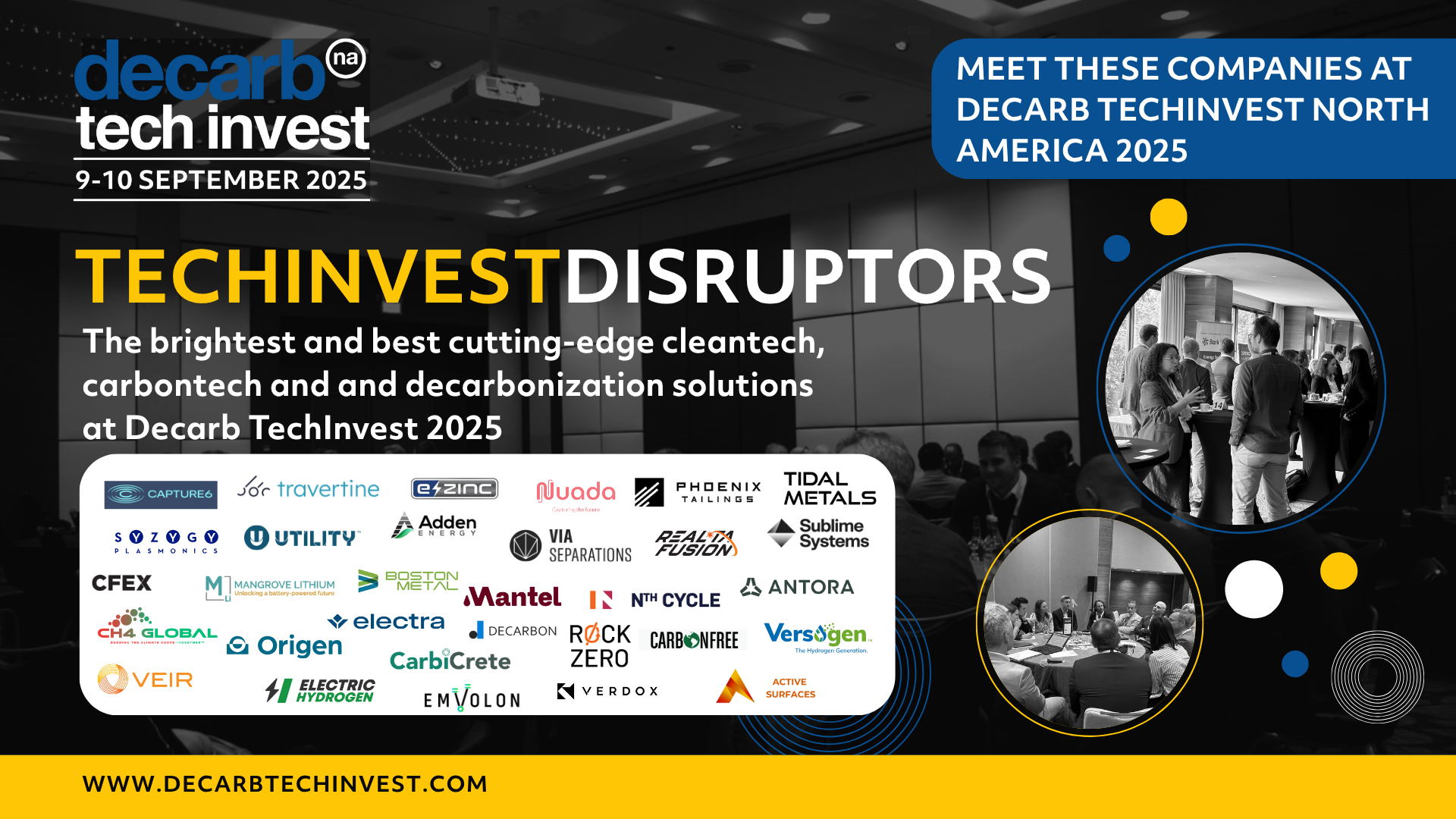
Tech Disruptors Report
The report showcases 30+ hardware innovators driving real progress in industrial decarbonization, from clean hydrogen and carbon removal to low-carbon materials.
Featured companies, including Utility Global, Boston Metal, Sublime Systems, and more, are disrupting the sectors in which they operate to tackle the deeply entrenched challenges of decarbonizing process industries.
This report offers a snapshot of the founders and technologies shaping the sector. Whether you’re an investor, corporate, or policymaker, it’s a valuable guide to the tech and talent leading the charge in decarbonization breakthrough technology.